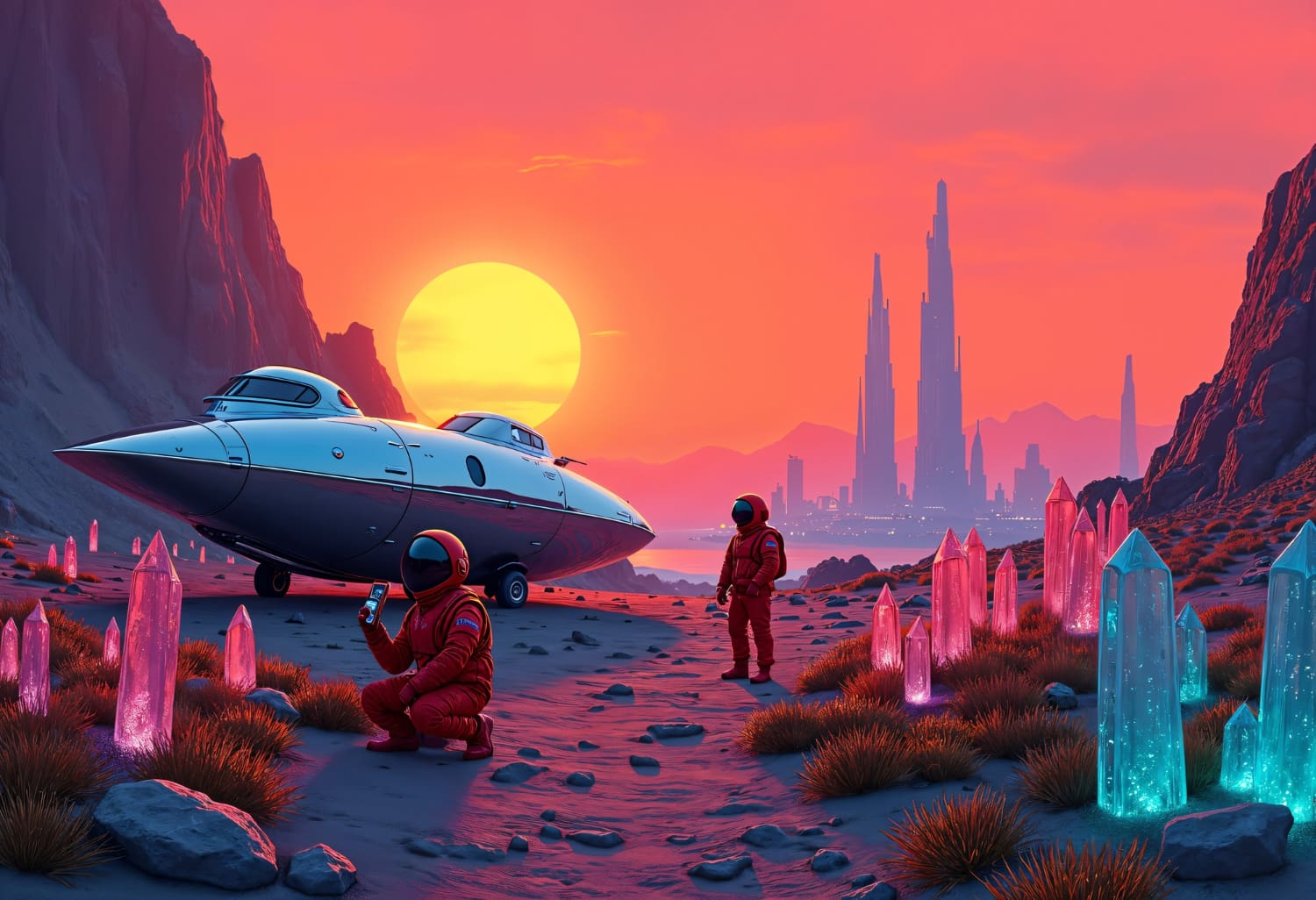
On the surface of an alien world, explorers witness a scene of breathtaking beauty. A radiant sun sinks toward the horizon, painting the sky in hues of pink and orange. In the foreground, clusters of towering crystals glow with internal light—emerald, violet, and sapphire shades sparkling against the rocky terrain. This is not a dreamscape but a tangible reality for astronauts venturing beyond Earth.
Their spacecraft rests nearby, a sleek vessel ready to carry them further into the cosmos. Yet, for now, the crew pauses to study this extraordinary landscape. The crystals are not merely beautiful; they may hold valuable scientific and technological secrets. Some pulse faintly, suggesting unique energy properties, while others shimmer in patterns that hint at underlying structures. Collecting samples becomes both a mission priority and a privilege.
As astronauts kneel among the glowing formations, instruments in hand, they document every detail. Each shard tells a story of geological processes alien to our world, shaped by forces we can only begin to understand. The crystals may reveal clues about the planet’s composition, atmosphere, and even its potential to support life.
Beyond the crystals, futuristic towers rise in the distance, silhouetted against the sunset. Whether natural or constructed, their sharp forms remind travelers that this world holds mysteries waiting to be solved. The combination of natural wonder and possible civilization creates an intoxicating mix of exploration and discovery.
This moment captures the essence of interplanetary travel: the thrill of encountering environments that defy imagination, the scientific responsibility of studying them, and the emotional awe of standing in a place no human has ever been before.
The crystal fields beneath the alien sunset stand as a reminder of why humanity journeys into space—not only to survive but to marvel, to learn, and to expand the boundaries of possibility.
Leave a Reply